


Consulting Director ·
Part 2: The fix, in summary, and how long it takes
In the first part of this series I described how senior teams fall into a downward spiral when a crisis tests values and relationships that were assumed rather than maintained. This part describes the way out. I should warn you in advance: prepare to be underwhelmed. Nothing in the solution is new. What makes it work is not novelty but ‘intelligent’ design, consistency and courage.
The four building blocks
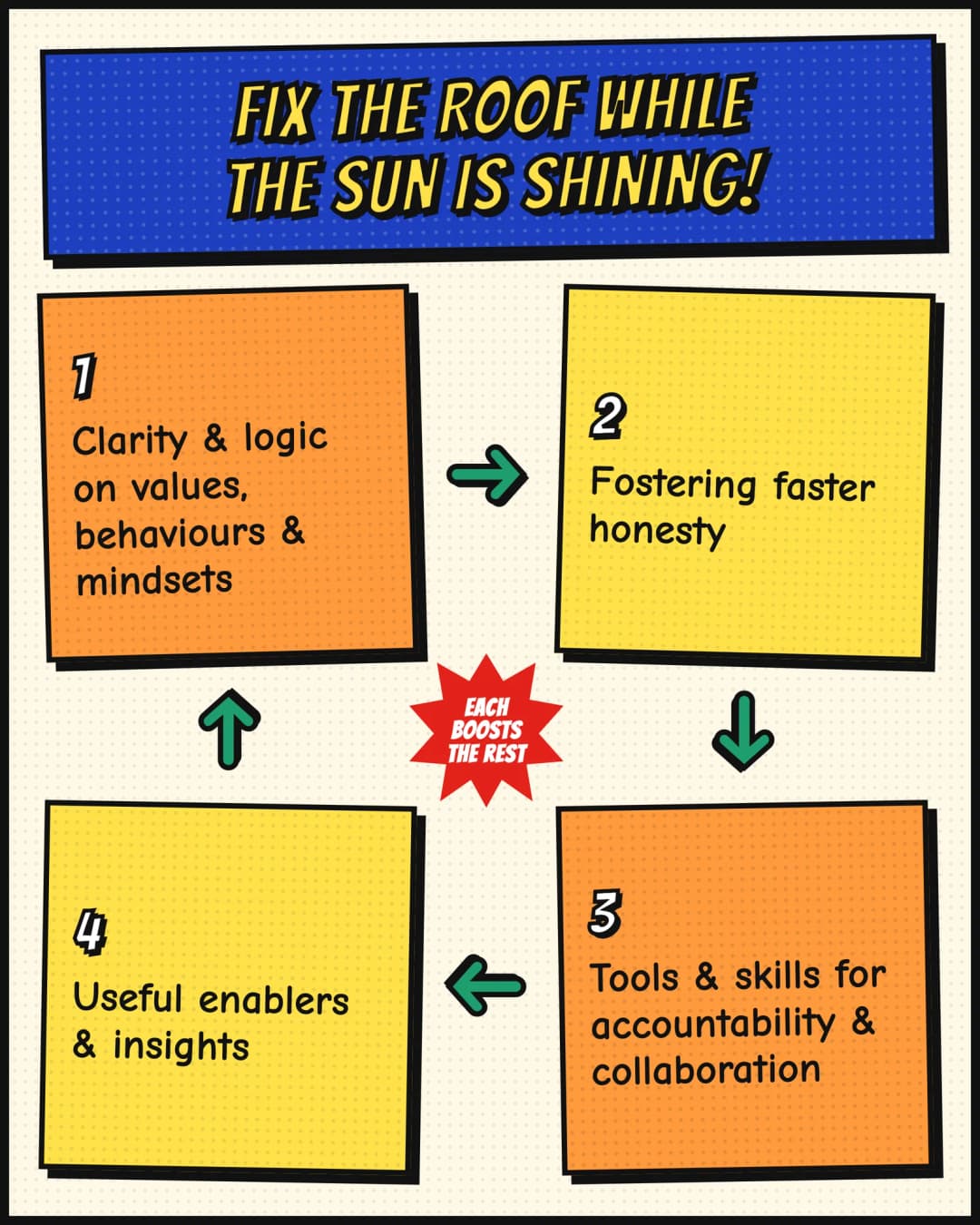
The solution has four building blocks. The first is clarity and logic about the team’s values, expected behaviours and mindsets. In plain terms: agreeing, in language everybody understands, how we show up for each other and what it actually means to be on this team. The second is fostering honesty and making this honesty fast. And speed in honesty really matters. Most teams are eventually honest with each other; the problem is that “eventually” is usually months too late. The third is a small set of tools, skills and routines that strengthen accountability and collaboration, such as better meetings, structured reviews and cleaner feedback. The fourth is a handful of insights and enablers that make the other three stick: how the brain actually learns new habits, what leadership commitment really means, and how to turn ego and vulnerability from obstacles into assets.
Psychological safety and accountability
These four blocks reinforce each other, and their effect is cumulative. Together they let a team strike the right balance between psychological safety and accountability. That balance matters, because the two are often treated as if they pull in opposite directions, as if a safe team must be a soft team. The opposite is true. Psychological safety, properly understood, is the condition that makes high accountability possible. It is not about being nice, keeping everyone comfortable or lowering standards. It is about making it safe enough to tell the truth that standards can be held high. Part 5 of this series goes into that balance in detail.
Design, consistency and courage
Here is what makes these ordinary components work when so many team-building efforts fail. Three things. First, intelligent design: each component rests on some clear thinking about why teams behave as they do, so it addresses a cause rather than a symptom. Second, commitment and consistency: the components are applied routinely and habitually, not “time permitting” or “when we need them”. A monthly conversation about how the team is working is only useful if it happens every month, including the months when it feels unnecessary. Third, moral courage: the components are applied even when, actually especially when, doing so is hard or feels risky. If a team drops its habits the moment things get difficult, it will simply revert to type at the next crisis, and all the earlier work is wasted.
Six months, one or two at a time
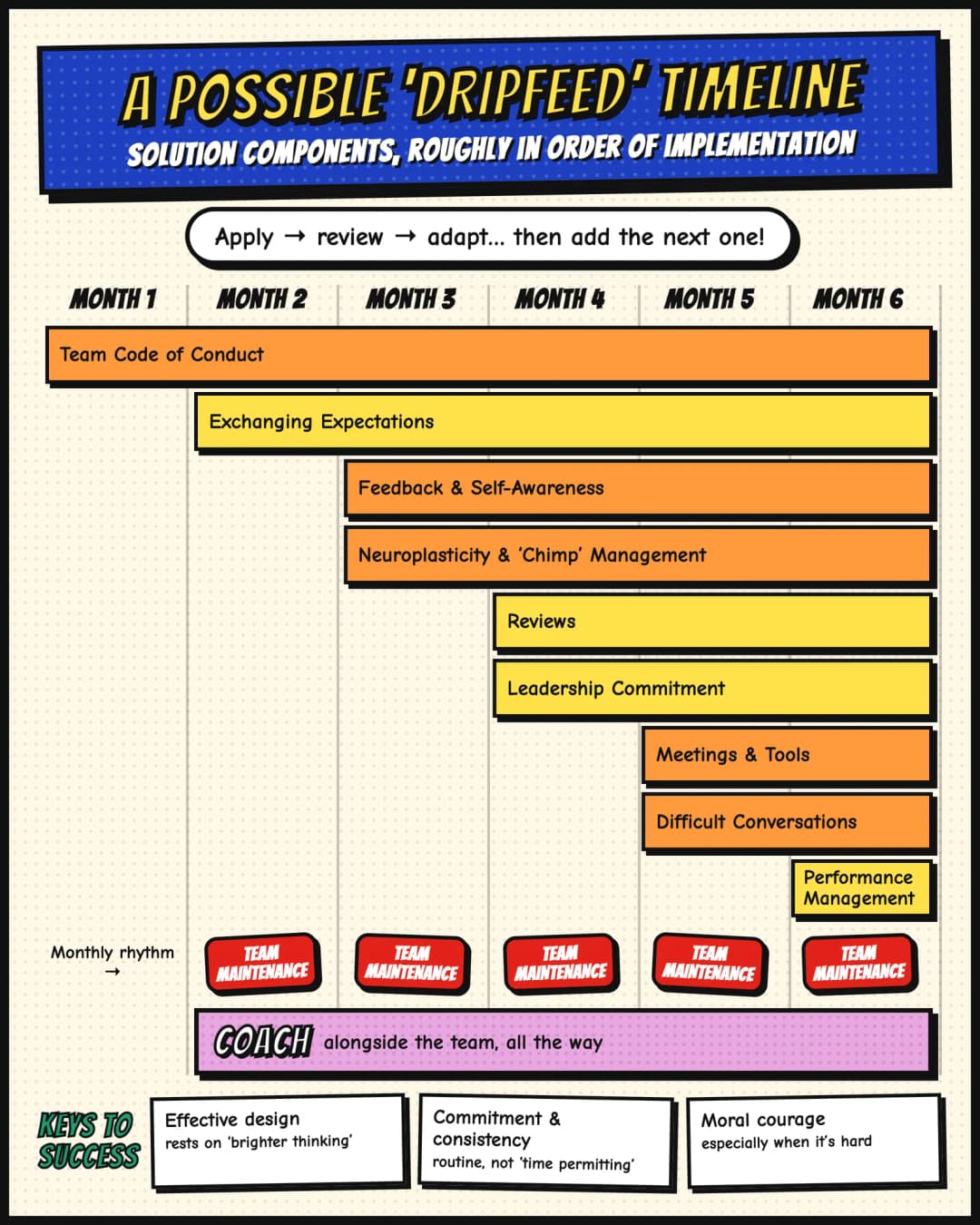
Now to timing. Most teams introduce the components over about six months, one or two at a time, in roughly this order. Month one: agree a Team Code of Conduct. Month two: start monthly ‘Team Maintenance’ and begin the one-to-one conversations we call Exchanging Expectations. Month three: build the feedback and self-awareness skills and spend a short session on how the brain forms habits. Month four: introduce structured reviews and agree what leadership commitment actually means in this team. Month five: improve the meeting rhythm and the supporting tools, and train people in difficult conversations. Month six: sharpen performance management so that what gets rewarded, including behaviours, matches what the strategy needs. Coaching support typically runs alongside from month two.
What governs the pace
That sequence is a starting point, not a rule. Two things govern the pace. The first is whether the previous component has landed: we apply, review and adapt before moving on, rather than piling on the next thing. The second is how often the team is actually in a room together, which depends on diaries, geography and whether people are co-located. A team that meets fortnightly will move faster than one that meets quarterly.
Fix what is weak, not what is working
Not every team needs every component. Some already have well-embedded behaviours through a strong code of conduct. Some already run good reviews or have a disciplined meeting rhythm. Where that is the case, those components come out of the plan. The point is to fix what is weak, not to rebuild what is working.
Time-neutral, and often time back
A reasonable objection at this point is time. Senior teams are busy, and this sounds like more meetings. In our experience the solutions are time-neutral overall and often give time back. There are three reasons. The components are built into the flow of existing work rather than bolted on as separate events. Once embedded, the extra clarity and stronger relationships remove a great deal of friction, rework and avoidable conflict, and the research on team effectiveness bears this out. And several of the more administrative pieces, such as capturing expectations, tracking feedback and preparing reviews, can now be made much lighter with AI tools.
What comes next
The next two parts take each component in turn: what it is, what is different or intelligent about it, and why it works.
Next in the series: Part 3: Agreeing how we show up for each other.