


Consulting Director ·
“Is a senior leadership team a strategic asset to the organisation?” It is a question I often ask clients. What follows is a look around the room and, mostly, this answer: “Err… well, it is, or it should be!”
So why do we maintain every other critical asset in the business, but somehow assume that a high-performing team magically appears?
What follows is a five-part series on why this obvious omission is so prevalent, and how to do something about it.
Part 1: Did you fix the roof while the sun was shining?
Most senior leadership teams do not fail because they lack talent or strategy. They fail because they assumed something about themselves that turned out not to be true, and they only found out when it was too late to do anything about it.
What we mean by “the roof”
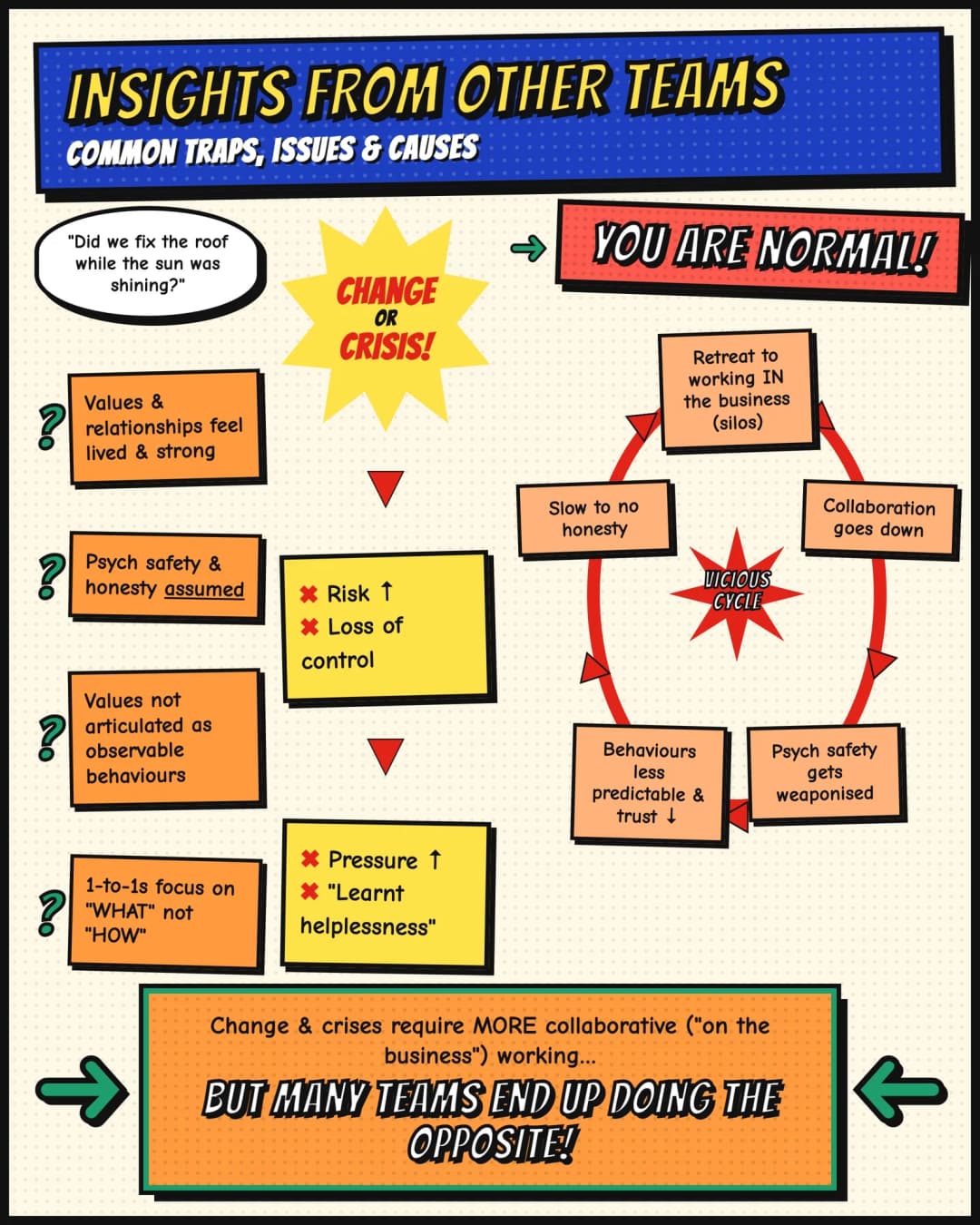
Here is the pattern we see again and again. When things are going well, a senior team assumes that the roof over its head is sound. By “the roof” I mean the things that protect a team when the weather turns: its shared values, the way its members behave towards each other, what they believe about their job as a team, and the quality of their relationships. In good times nobody inspects the roof. Why would you? It is not raining.
What goes unattended in the good years
So, a few things quietly go unattended. Psychological safety is assumed rather than checked. Everyone believes people would speak up if something were wrong, but nobody has tested that belief. Honesty is assumed too. The team’s values exist, usually on a poster or a slide, but they are written as fine-sounding words rather than as behaviours you could actually observe. “Integrity” and “collaboration” mean something slightly different to every person in the room, and nobody notices because nothing has forced the difference into the open. And the one-to-one conversations between team members focus almost entirely on what they are working on together, and almost never on how they are working together.
None of this feels like a problem. That is the trap. Values get tested in a crisis, not in a good year.
When the weather turns
Then the crisis or the big change arrives. A restructuring, a lost contract, a new owner, a market shock, a failed product. And the team discovers that it did not fix the roof while the sun was shining. What follows is a downward spiral, and it is remarkably consistent from one team to the next.
The downward spiral
The change raises risk, real or perceived. People feel a loss of control. Pressure goes up, and in some team members a kind of learned helplessness creeps in: a sense that nothing they do will make much difference. The natural human response to that feeling is to retreat to the place where you still feel in control, which for a senior leader is their own department or division. So, people pull back into working in the business rather than on it. They become heads of function again rather than members of a leadership team.
Once that happens, collaboration drops. As collaboration drops, people’s behaviour becomes less predictable to each other, because you no longer see enough of your colleagues to know what to expect from them. Unpredictability erodes trust. As trust falls, psychological safety falls with it, and in the worst cases it gets weaponised: “I’m just being honest” becomes a licence to attack, or “that’s not psychologically safe” becomes a way to shut down legitimate challenge. Lower safety pushes people even further into their silos, and the cycle tightens.
What breaks the cycle
There is a circuit breaker in this loop, and it is honesty. If somebody says early, in the room, “we are retreating into our corners and it is hurting us,” the spiral can be stopped. Honesty should be the strongest beam in the roof. But in most teams, it was assumed rather than practised. It was never turned into a habit while the weather was good, so it is not available when the weather turns bad.
Less of everything, just when you need more
The cruel irony is that a crisis demands the opposite of what the team ends up doing. Major change needs more collaboration, more working on the business together, more collective ownership of the risks. Instead, the team gets less of all three, exactly when it needs them most.
Three questions to ask while it is still sunny
If you lead or sit on a senior team, three questions are worth asking now:
- Could every member of your team describe your values as behaviours that a colleague could see and name?
- When did somebody last tell the team an uncomfortable truth, and what happened to them?
- Do your one-to-ones ever cover how you work together, or only what you are working on?
What comes next
If the honest answers make you uneasy, that is useful information. The rest of this series is about what to do with it. The good news is that the fix is not complicated. It is a set of tried and tested habits, applied consistently and with some courage. The next part sets them out.
Next in the series: Part 2 of 5 — The fix, in summary, and how long it takes.