


Consulting Director ·
Part 3: Agreeing how we show up for each other
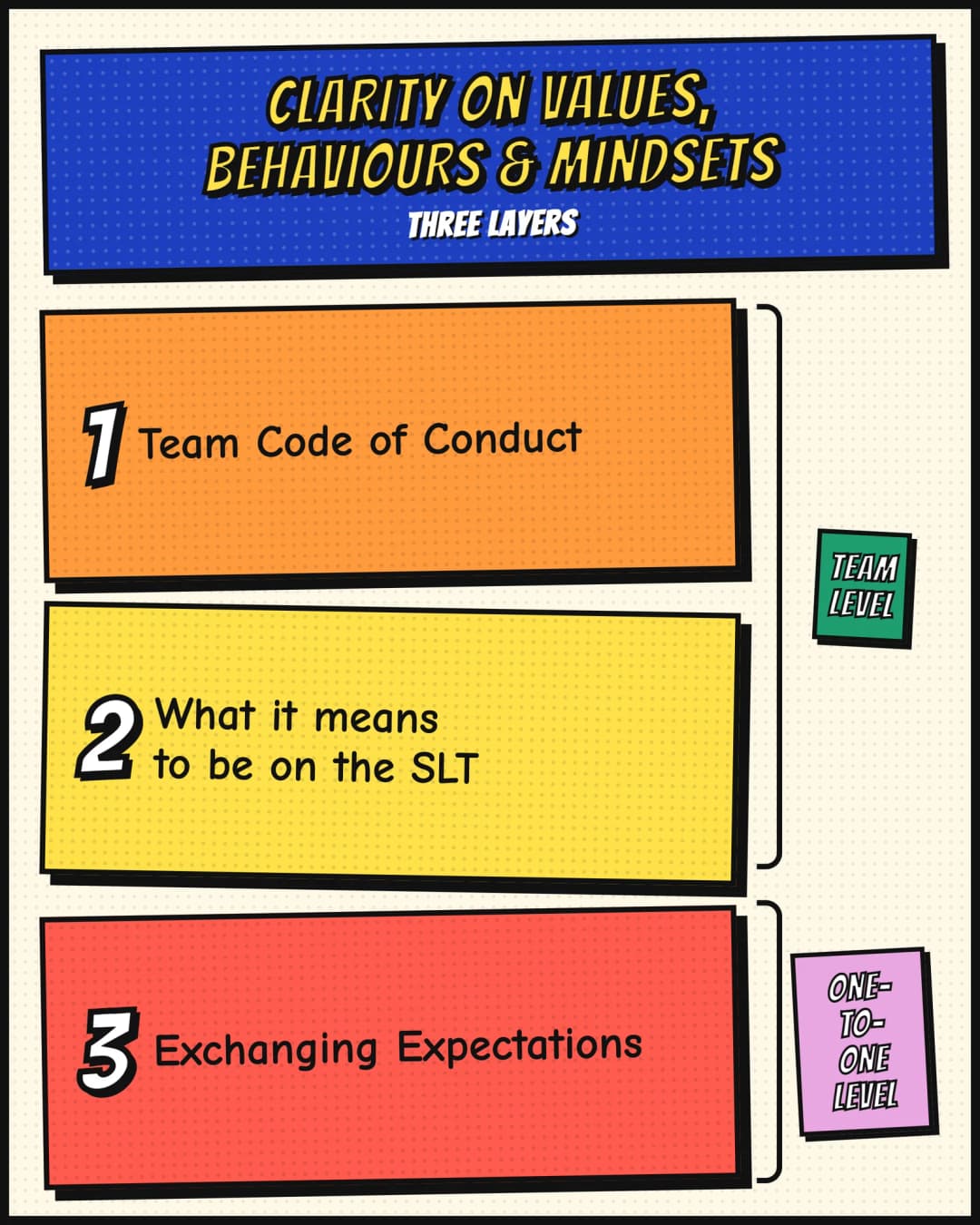
The first job in resetting a senior team is to remove ambiguity about how its members will treat each other and what the team is for. Three components do this: a Team Code of Conduct, an explicit agreement about what it means to be on the senior team, and a series of one-to-one conversations we call Exchanging Expectations. The first two create clarity at team level. The third creates it between individuals. Together they give the team something concrete to be honest about later, which is why they come first.
The Team Code of Conduct
Start with the Team Code of Conduct. This is a short list, ideally eight to ten rules, that describes in plain language the behaviours the team expects of itself and, where necessary, the behaviours it will not accept. It is written by the team, for the team. It can and should connect to the organisation’s vision and values, but it is not a restatement of them. It answers a more personal question: how do we show up for each other?
Every rule an observable behaviour
What makes a code intelligent rather than decorative is that every rule is an observable behaviour. Not “we value respect” but “discuss issues in the team, not outside it”. Not “we are open” but “we can cope with bad news but not with surprises”. The difference matters because you can only hold somebody to account for something you can see. Fine words about integrity cannot be breached in any way a colleague could point to. “Say what we do, do what we say” can.
Why a code works
Why does it work? Because, as the old saying goes, culture eats strategy for breakfast. In the best teams, trust and psychological safety stay high because behaviour is predictable: people know what to expect from each other and they get it. Predictability strengthens honesty, and honesty strengthens relationships. A good code covers three kinds of behaviour, which we call Safe, Happy and Fast, and applies them in that order, because a team can only perform well if it is happy, and can only be happy if it feels safe. Part 5 of this series is devoted to that framework and includes real examples from teams we have worked with. One more thing: the code is not written and filed. Adherence is checked every month in a short conversation called Team Maintenance, which Part 4 describes.
What it means to be on the senior team
The second component is an agreement about what it actually means to be on the senior leadership team. This is a team-level exchange of expectations, and some teams fold it into the code of conduct. It covers questions that most senior teams have never answered out loud. What is the right balance between working on the business, strategically and collectively, and working in the business, running your own department? When your department’s interests and the company’s interests pull in different directions, which wins, and how will we decide? Will you give up your best people to a company priority? Who owns the risks that fall between departments?
Club versus country
We sometimes call this “club versus country”. Every leader captains a club, their function, and also plays for the country, the business as a whole. Without an explicit agreement, club wins by default, because that is where each leader’s targets, budget and loyalty sit. This matters most in volatile times, when cross-departmental dependencies multiply. A large-scale survey of strategy execution, covering more than 7,600 managers in over 260 companies, led by Donald Sull of MIT Sloan with Rebecca Homkes of London Business School, found that failure to coordinate across units was one of the two most commonly cited obstacles to executing strategy: 30% of managers named it as their greatest challenge, and only 9% said they could rely on colleagues in other functions and units all the time. In most businesses the question of how leaders add value beyond their own function is simply never challenged, so narrow departmental focus becomes the norm. Answering the question explicitly, and writing the answer down, changes that.
Exchanging Expectations
The third component moves from the team to the pair. Exchanging Expectations is a structured one-to-one conversation between two members of the senior team. Most senior leaders already have one-to-ones, but those conversations almost always cover the “what”: the projects, the numbers, the deliverables. Exchanging Expectations adds the “how”. How do you like to work? How often, and in what form, do you want to hear from me? And critically, how will we handle conflict? Three questions do most of the work here. Help me understand what triggers conflict in you. If a disagreement is brewing between us, how shall we flag it? How far can we challenge each other, and how?
When to have the conversation
The typical moments for this conversation are a performance review, a new working relationship, a major change, an issue or a crisis, or simply a decision to reset. It is not a one-off. Expectations are revisited regularly, because people and circumstances change. A simple template guides the conversation, and AI tools can capture the outcome so that it does not evaporate.
Why exchanging expectations works
Why does it work? Research on team conflict suggests that most damaging disagreements are not about what people are trying to achieve but about how they get there and how they work together along the way. Karen Jehn’s work distinguishes task conflict, which can be productive, from process and relationship conflict, which consistently undermine performance, and a 5,000-person CPP survey found that personality clashes, stress and unclear roles, rather than differences over goals, are the most commonly cited causes of workplace conflict.
Talking about the “how” up front removes a great deal of that friction before it starts. And there is a second, subtler benefit. When people hit a problem with a colleague, they are often reluctant to give feedback because there was never an agreement to base it on. Exchanging Expectations creates that agreement. Later feedback becomes a conversation about something we both signed up to, rather than an accusation out of the blue.
Making the implicit explicit
These three components share a single purpose: to make the implicit explicit. Once a team has said out loud how it will behave, what it is for, and how its members will work with each other, it has something to hold itself to. The next part is about how to keep holding it there when the pressure comes on.
In part 4 we will explore Fast Honesty and how we maintain it.