

Consulting Director ·
Part 5: Safe, Happy, Fast: a code of conduct that moves both dials
A senior team’s code of conduct is worth getting right, because it is the thing every other habit hangs off. This final part explains the framework we use to write one, which we call Safe, Happy, Fast, and shows why a code built this way raises psychological safety and accountability at the same time rather than trading one off against the other.
Two dials, four zones
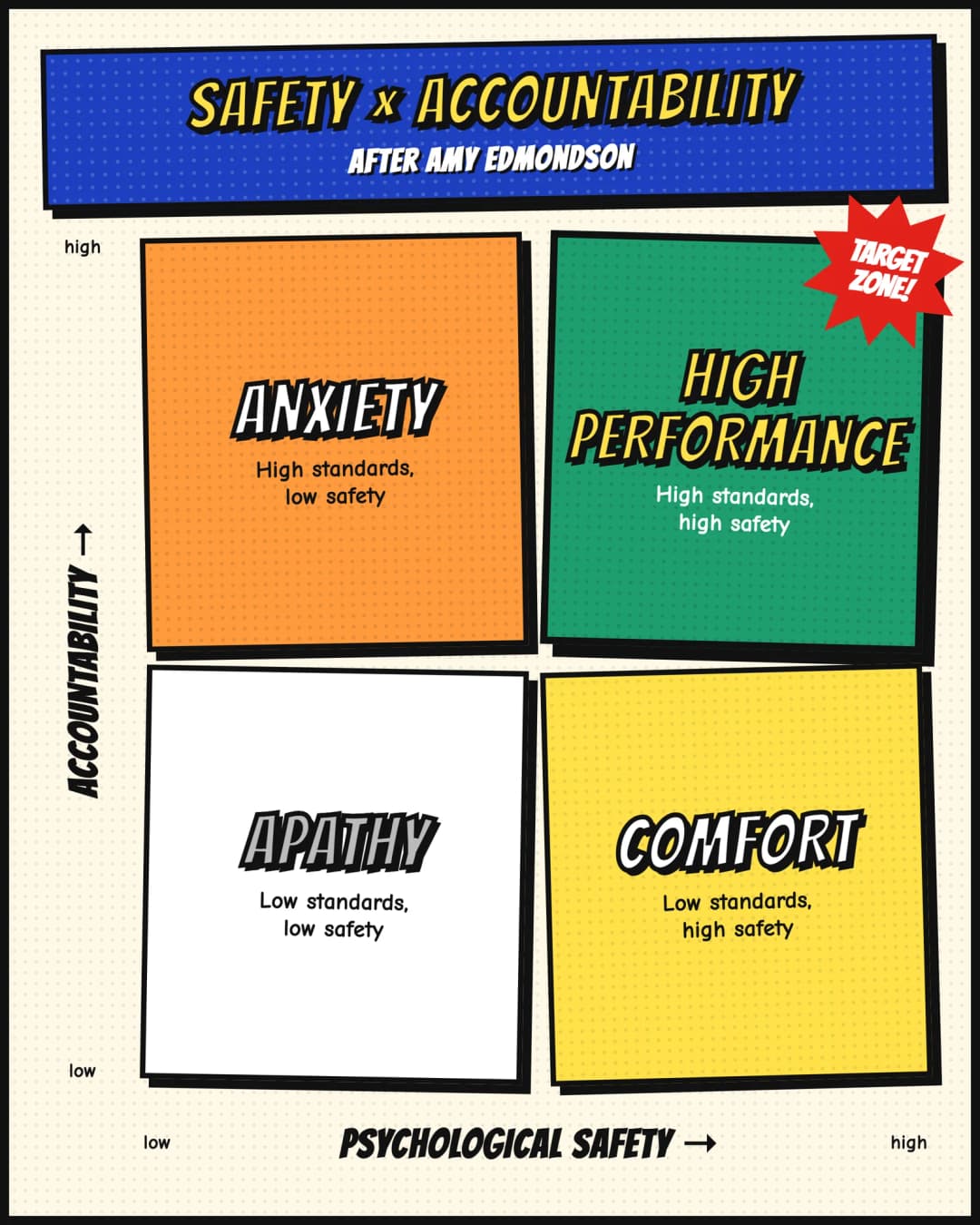
First, a word on that trade-off, because it is the most common misunderstanding about psychological safety in senior teams. Many leaders hear “psychological safety” and picture a team where nobody is challenged, nobody is uncomfortable and standards quietly slip. Amy Edmondson, who did the foundational research, has been clear that this is wrong. Her work describes two dials, psychological safety and accountability, and four zones. Low on both, and you have apathy. High safety with low accountability gives you a comfort zone, pleasant and unproductive. High accountability with low safety gives you anxiety, where people hide mistakes and stop taking risks. The high-performance zone is high on both. Safety is what makes it possible to hold standards high, because people will only own up to a shortfall, ask a hard question or challenge a decision if they know they will not be punished for it.
Safe, Happy, Fast
The Safe, Happy, Fast framework is a practical way of writing rules that push both dials up. The order is deliberate. A team can only perform if it is happy, and it can only be happy if it feels safe. So, we start with Safe.
Safe rules
Safe rules are the behaviours that guarantee psychological safety (and physical safety if that applies in the team’s environment). The outcomes they protect are that people feel included, can admit mistakes, can contribute, and can challenge and dissent without fear of retribution. Real examples from teams we have worked with include “discuss issues in the team, not outside it”, “challenge with positive intent”, “psychological safety cannot be weaponised” (you may not use it as a shield against legitimate challenge), “do what we say, say what we do”, and, from a senior client team, the blunt “share sh*t”. A round-the-world yacht crew that went on to win their race had “celebrate our diversity”. Notice that every one of these is behaviour, and several of them are accountability rules in disguise. “Discuss issues in the team” is a safety rule and an accountability rule at once.
Happy rules
Happy rules are the behaviours that sustain performance, individual and collective. “Sustain” is the key word: the rules must deliver wellbeing, motivation, respect, mutual support, fairness and stronger bonds, or the performance will not last. Examples from real teams are some of the most memorable. “Leave it on the waves behind” came from that same yacht crew, and it means that a bust-up at sea is over when the watch changes. “We can cope with bad news but not with surprises” is one of the most powerful rules we have seen, because it makes early self-reporting of problems, near misses and mistakes the expected thing to do rather than an act of bravery. “No one is done till everyone’s done.” “Stop looking for the fatal flaw”, from a team whose challenge habit had drifted into reflexive fault-finding with diminishing returns. “No double standards, ever.” “Go first”, meaning be the one who admits the mistake or shows the vulnerability. “Signal anything that impacts others.” “Drink more tea”, which meant sitting down with colleagues without a work agenda and getting to know them as human beings. “Choose your mood, but don’t wear a mask.” “Team ego over own ego.” And, in one team, simply “don’t be a dick”.
Fast rules
‘Fast’ rules are the behaviours that drive performance, accountability, compliance and learning. Unlike Safe and Happy rules, they are highly specific to the team, because they flow from its purpose, its risks, what sets it apart and how it defines success: speed, market share, growth, innovation, quality, financial health or some combination. That also means they should change as the team’s situation changes. Examples include “an 80 per cent solution on time beats a 100 per cent solution too late”, from a team that had a habit of over-engineering. “Follow the money”, from a team that agreed every department would back whichever initiative made the most money for the business, even when that meant putting another department’s project ahead of its own targets. “We will always change sails if it makes the boat go faster.” Again, from a race-winning yacht crew. “People first.” From a highly successful startup who held that — counterintuitively — putting the wellbeing of their own staff first, would make them excel at customer service, their key differentiator. It worked.
Less is more
Two principles govern the whole code. Less is more: aim for no more than eight to ten rules across all three categories, because a code nobody can remember is a code nobody follows. And however the team chooses to hold each other to its rules, it does so with compassion, kindness and a bit of levity. The point of the code is not to catch people out. It is to make the standard clear enough that living up to it becomes easy and falling short becomes visible.
Moving both dials at once
Now look at how a code written this way moves both dials at once. Almost every rule above does one of two things. Some are pure safety rules that also raise accountability: “we can cope with bad news but not with surprises” makes it safe to report a problem and makes not reporting it a breach. “Go first” turns admitting mistakes into an obligation, not a risk. Some are pure accountability rules that only work because they are safe: “follow the money” asks a leader to subordinate their own targets, which they will only do in a team where that sacrifice is seen and respected. “Stop looking for the fatal flaw” protects challenge by stopping it from curdling into blame.
The same logic, right through
The same logic runs through the rest of the programme. Team Maintenance is a safety practice (an honest conversation about how we are working) and an accountability practice (a monthly check against the code). Exchanging Expectations makes it safe to raise a problem and makes the expectation explicit enough to be held to. Reviews run on just-culture principles create learning without blame, and blame-free learning is what allows people to be accountable for the next decision. Inviting feedback before giving it is a vulnerability that earns the right to hold others to a standard. In every case, safety is the enabling condition and accountability is the outcome.
The chief anarchist
One chief executive we worked with described his role as “chief anarchist”: the person whose job was to invite challenge, appoint a loyal opposition and ask for the pre-mortem nobody else wanted to run. That is what leading for both dials looks like. It is not a soft option. It is the harder path, and it is the only one that holds when the roof is tested.
Write one thing down
So if your team is going to write one thing down this year, make it a Safe, Happy, Fast code of conduct: eight to ten observable behaviours, written by the team, checked every month, and held to with kindness. Then fix the roof while the sun is shining.