
Founding Director ·
Over the past 25 years, we have seen the talent development market change fundamentally.
When Mission Performance first began designing leadership and talent programmes, most organisations were, in effect, buying events. Leadership development usually meant taking groups of high‑potential individuals away from the workplace, placing them into challenging environments and hoping that the experience would translate into meaningful behavioural change once they returned to their roles.
At the time, this approach was considered progressive.
Through work with organisations such as Accenture, the use of Royal Navy environments including HMS Excellent, and later the design of immersive leadership experiences inspired by the BT Global Challenge for British Telecom Wholesale, we exposed future leaders to pressure, ambiguity, teamwork and complex decision‑making in ways that classroom learning could not replicate.
These experiences were, and remain, highly impactful.
What has changed is what organisations now expect. Large organisations no longer want isolated leadership programmes that sit apart from operational reality. Instead, they want integrated systems that help them identify, assess, develop, retain, and accelerate talent at scale, while also demonstrating clear behavioural and organisational impact.
This expectation has driven a significant shift in our own thinking.
Over time, it became evident that one‑off interventions, however memorable, rarely create sustained change on their own. Long‑term performance improvement requires reinforcement, operational alignment, leadership visibility, coaching, diagnostics, measurement and, increasingly, technology that supports behaviour over time.
As a result, Mission Performance has evolved from delivering leadership events into building behavioural infrastructure.
Today, our work integrates behavioural diagnostics, experiential learning, Human Factors, neuroscience, coaching, organisational insight, behavioural analytics, leadership development and AI‑enabled reinforcement into a single, cohesive system.
This approach is embodied in what we call the Performance Loop: Measure, Train and Sustain. The aim is simple—not merely to educate individuals, but to change behaviour at scale in ways that measurably improve organisational performance.
Why Experiential Learning Still Matters
Despite the rise of digital technology, demand for immersive learning experiences is increasing again.
Modern work has become increasingly virtual, transactional and screen‑based, yet people continue to learn most powerfully through meaningful human experience.
Experiential learning today, however, must be more sophisticated than it was 20 years ago. It needs to integrate neuroscience, behavioural science, psychological insight, operational relevance, measurable outcomes and post‑event reinforcement.
At Mission Performance, we have always referred to this as the intelligent use of the outdoors. The experience itself is never the point. The behavioural insight created by the experience is the point.
Without reinforcement, experiences become memories. With reinforcement, they support behavioural change.
Leadership Through Experience
When Mission Performance began, experiential learning was still relatively uncommon in large organisations. Most leadership development was classroom‑based, theoretical and often disconnected from operational reality.
We took a different view. We believed leadership could not truly be learned in abstraction. People discover who they are when they are under pressure, facing uncertainty, working with constrained resources, operating with fatigued teams and making decisions where the consequences genuinely matter.
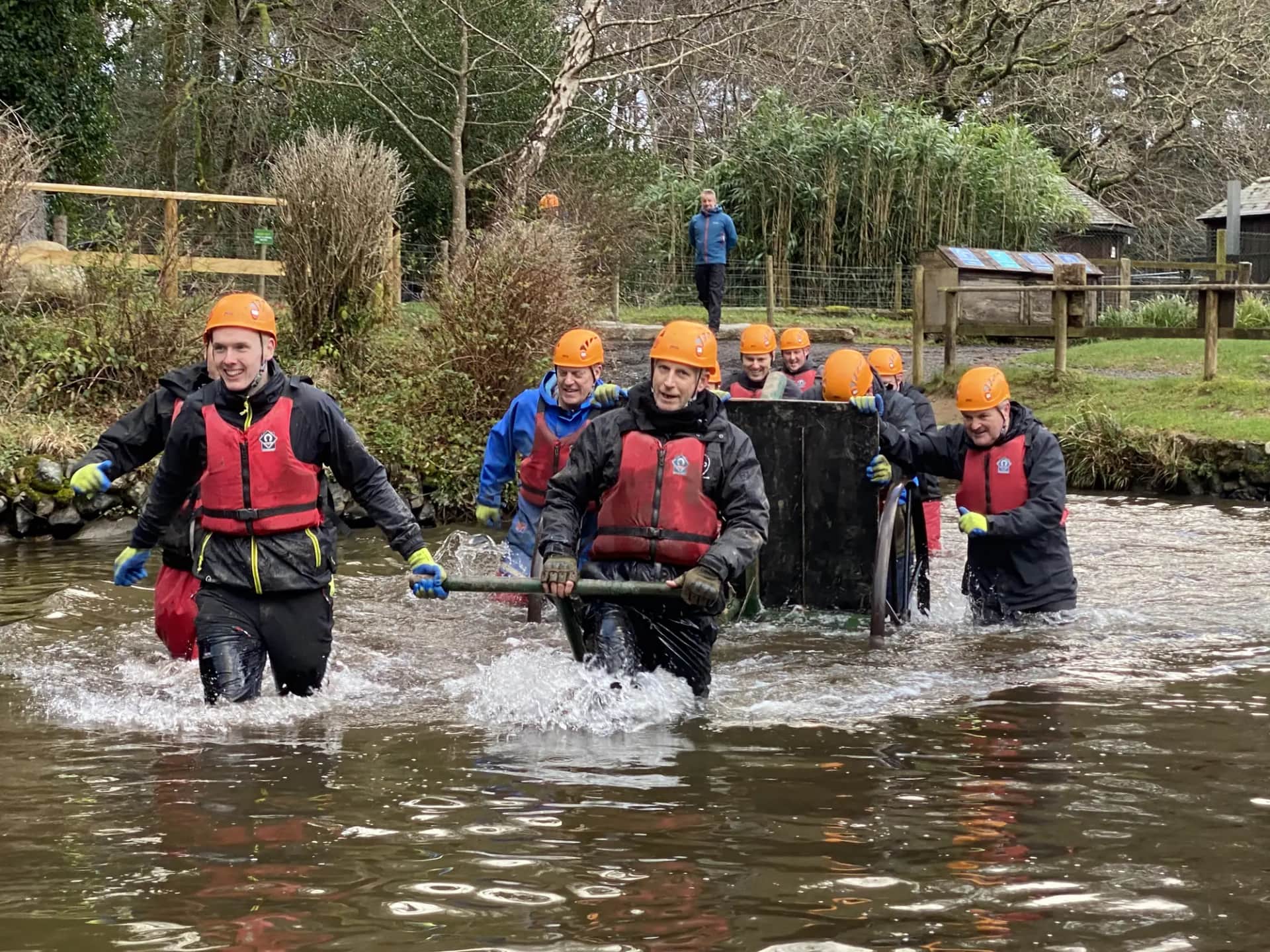
That belief shaped our early work. We developed immersive experiences combining challenge, reflection and operational realism, drawing on Royal Navy and Royal Marines environments, offshore sailing, live simulations, expeditions, shared hardship and adaptive team exercises.
These programmes worked because the learning was emotionally real. Participants did not simply discuss teamwork or resilience; they experienced them directly. The emotional intensity accelerated trust, self‑awareness and behavioural insight in ways traditional learning environments rarely achieve.
At the time, this significantly differentiated us from conventional providers. However, over the years, a pattern became increasingly clear. Even the most powerful experience will fade if the organisational system surrounding it remains unchanged.
That realisation marked a turning point in our thinking.
The Shift from Events to Systems
Over the past decade, organisations have become far more demanding consumers of leadership and talent development, and rightly so.
Boards and executive teams now expect development investment to demonstrably improve leadership capability, operational performance, retention, succession strength, cultural behaviour, collaboration, adaptability, safety and productivity.
Engaging training alone is no longer enough. Without evidence of behavioural change, development is increasingly viewed as costly theatre rather than a driver of performance.
This has fundamentally changed the conversation. Where organisations once asked, “Can you run a leadership programme?”, they now ask, “How can you help us change behaviour at scale?”
That is a very different challenge, and one that requires a whole‑system approach rather than a single learning intervention.
In response, our work evolved beyond delivery into behavioural diagnostics, organisational insight, capability mapping, leadership pipeline development, coaching, reinforcement mechanisms, behavioural sustainment and performance analytics. The intervention itself became just one component of a much larger behavioural ecosystem.
Redefining Talent in the Age of AI
Artificial Intelligence is accelerating this shift even further.
As AI increasingly automates routine cognitive activity, organisations are being forced to rethink what “high potential” actually means. Future competitive advantage will not come purely from technical expertise or access to information. It will come from deeply human capabilities, including judgement, adaptability, emotional regulation, systems thinking, communication, collaboration, ethical decision‑making, resilience and the ability to operate effectively under ambiguity.
Many of the capabilities now most critical to organisational success are the same capabilities we have spent 25 years developing through experiential challenge and behavioural coaching.
This places Mission Performance in a distinctive position. We operate at the intersection of human performance, leadership development, behavioural science, AI augmentation and organisational execution—an integration that few providers truly deliver in practice.
Hidden Capability and Internal Mobility
One of the most significant changes we now see inside large organisations is the recognition that external recruitment alone cannot solve capability shortages.
The real challenge lies in identifying and accelerating hidden capability that already exists within the organisation. The war for talent has increasingly become a challenge of retention, redeployment, succession acceleration, internal mobility and capability discovery.
Addressing this requires organisations to become much better at identifying latent leadership capability, promotability, adaptability, behavioural risk, resilience patterns and leadership readiness.
Traditional psychometrics alone are no longer sufficient. Our approach combines behavioural diagnostics, applied observation, experiential assessment, qualitative insight, quantitative evidence and live simulation.
What matters is not simply how people describe themselves in calm environments, but how they behave under pressure, within teams, during ambiguity, when challenged and when leading change. This creates a far richer and more accurate understanding of leadership capability.
Frontline Leadership as a Strategic Lever
Another major shift has been the growing recognition that organisational culture is largely shaped by frontline leadership.
For many years, organisations overinvested in senior executives with vague expectations about the returns on that investment, while simultaneously underinvesting in supervisors, middle managers, operational leaders and shift leaders. This imbalance is now being corrected.
Culture succeeds or fails in everyday behaviour, particularly across sectors such as engineering, manufacturing, energy, logistics, healthcare, infrastructure and transport.
As a result, the future of talent development is not about elite executive coaching alone. It is about scalable leadership support across entire operational populations.
Small behaviours, repeated consistently across large numbers of people, create profound cultural change over time. This principle sits at the heart of our work today.
Psychological Safety and Accountability
Our thinking around culture has also evolved.
Culture is often treated as something soft, abstract or disconnected from execution. We see it differently. Culture is how work actually gets done.
It shows up in decision‑making, accountability, communication, trust, challenge, candour, operational discipline and collaboration.
Research into psychological safety has helped organisations understand the importance of creating environments where people feel able to speak up. What organisations increasingly want now is operational application.
They want environments where people challenge appropriately, hold standards, collaborate honestly, learn quickly and adapt under pressure.
Psychological safety and accountability are not opposites. The strongest cultures require both.
Moving Beyond “Happy Sheets”
One of the healthiest developments in our industry has been the growing demand for meaningful measurement.
For many years, leadership development was evaluated primarily through participant satisfaction. Enjoyment and inspiration matter, but they are not measures of impact.
Today, organisations rightly expect evidence linked to behavioural transfer, retention, leadership progression, productivity, engagement, operational improvement and safety performance.
Advances in AI, behavioural analytics and sustainment technologies now allow behavioural change to be both measured and reinforced far more effectively than ever before.
The Performance Loop
All of this thinking culminated in the Performance Loop™.
The Loop brings together three interconnected elements: Measure, Train and Sustain.
Measurement uses diagnostics, observation and organisational insight to identify behavioural gaps, capability constraints, leadership risks, cultural blockers and performance leakage.
Training delivers immersive and experiential interventions that accelerate self‑awareness, adaptability, communication, collaboration, resilience and leadership capability.
Sustainment embeds behaviour through coaching, AI‑enabled support, peer learning, role‑play, behavioural nudges, manager engagement and direct application within live operational environments.
The objective is no longer temporary inspiration, but sustained behavioural execution.
Coaching at Scale
Historically, coaching was reserved for senior executives. Technology has fundamentally changed that.
Today, behavioural reinforcement and coaching can be scaled across entire organisational populations.
Our COACH platform enables organisations to reinforce learning continuously, provide real‑time behavioural support, develop internal coaching capability, support frontline leadership and sustain behavioural standards over time.
Importantly, this is not simply AI conversation. It is behavioural sustainment infrastructure, and that distinction matters.
In conclusion
Looking back over the past 25 years, the biggest shift is clear.
Organisations no longer want training for its own sake. They want behavioural execution. They want to identify, develop and retain talent in ways that directly improve organisational performance.
That requires far more than isolated learning interventions. It requires integrated behavioural infrastructure that combines diagnostics, leadership, Human Factors, experiential learning, coaching, AI augmentation, behavioural reinforcement and measurable sustainment.
That is where Mission Performance has evolved to.
What began as immersive leadership development has become a whole‑system approach to behavioural performance and talent acceleration. The organisations that thrive over the next decade will be those that recognise one simple truth:
Human capability, not technology alone, remains the ultimate differentiator.