

Founding Director ·
Sitting on the panel at this year’s iadc.org/" rel="noreferrer">IADC Drilling Middle East Conference, I was struck by how far the conversation around safety has evolved, and how much further we can still go. The session, “ Transforming Safety Practices Through Innovation and Technology,” brought together leaders, technologists, and practitioners all focused on one shared goal: keeping people safe in increasingly complex environments.
What became clear throughout our discussion is that safety is no longer just about compliance or checklists. It’s about connection – between people, data, and decision-making. Technology is giving us new tools to understand risk dynamically, but culture and leadership remain the real engines of transformation.
Technology + Human Performance = Sustainable Safety Culture
Using AI to Manage Risks Dynamically
Artificial intelligence and advanced analytics are opening up possibilities that were unthinkable even a few years ago. On the panel, we discussed how AI can process streams of operational data – from equipment sensors to environmental conditions – to predict potential hazards before they materialise.
But technology on its own doesn’t make the workplace safer. It’s how people use it that matters. Dynamic risk management requires trust in the data and clarity in decision-making. Teams must understand not only what the algorithms are telling them, but why. That means transparency in design, training for interpretation, and leadership that bridges the gap between technical insight and human judgment. It was heartening to hear from our audience that understanding Human Factors is fundamental to safety.
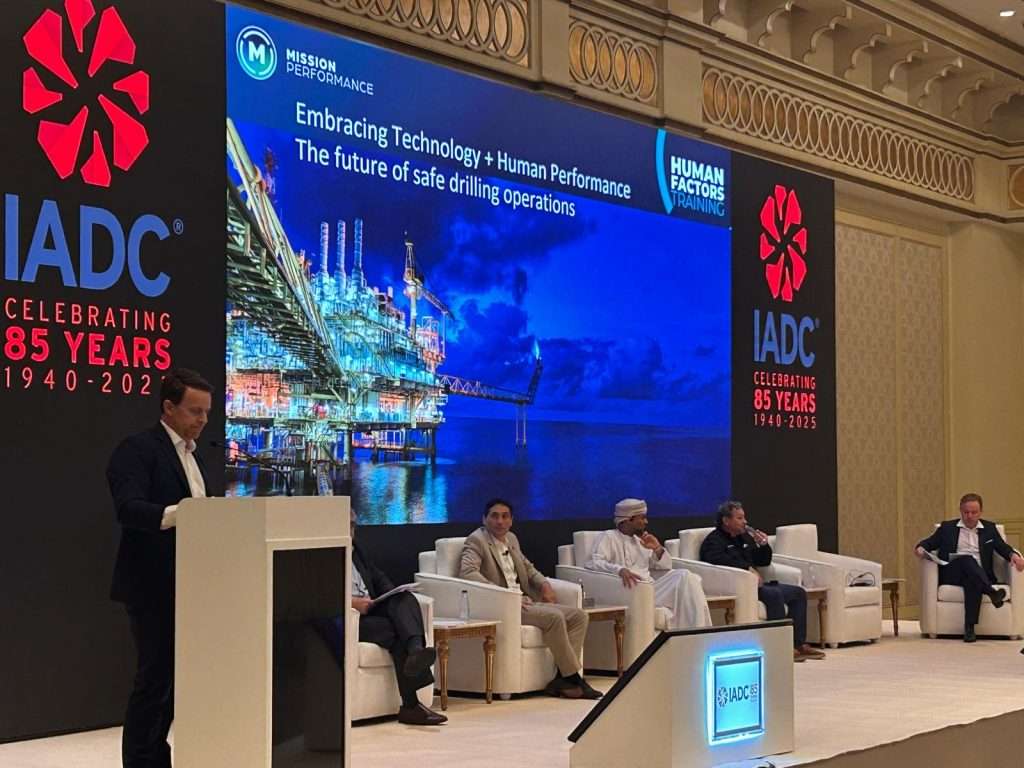 Chris Mcleod speaking at the IADC Drilling Middle East Conference" loading="lazy" decoding="async" />
AI can be a powerful enabler, but it should augment, not replace, human awareness. The best outcomes happen when data sharpens our perception, rather than dulling our intuition – AI is the co-pilot, not the captain.
Turning Incident Data into Real-Life Safety Principles
For too long, incident data has been a backward-looking tool used to explain what went wrong after the fact. What we’re seeing now is a shift toward learning from data in real time, and translating insights into principles people can act on day to day.
We talked about the importance of creating feedback loops that are fast, simple, and human. Data dashboards are only useful if the insights are communicated in a way that resonates with teams on the ground. Leaders need to turn analytics into stories, connecting the dots between a near-miss, a behavioural insight, and a meaningful change in practice.
At Mission Performance, we believe that data tells you what happened; people tell you why. The magic happens when those two perspectives meet – when analytics become a catalyst for collective learning rather than a compliance exercise.
Building Safety Programs That Actually Motivate People
Another powerful theme that emerged was the need to move from “have to” safety to “want
to” safety. Traditional programs often rely on rules, procedures, and metrics – and while those are essential, they don’t necessarily motivate people to care.
To create a genuinely proactive safety culture, we need to tap into values, purpose, and belonging. When individuals see how their actions protect their teammates and shape the wider performance of the organisation, motivation becomes intrinsic.
At Mission Performance, we’ve seen that leadership visibility and authentic communication make the biggest difference. People are inspired not by slogans, but by behaviour – by leaders who show up, ask questions, and listen. Coaching, storytelling, and everyday conversations can turn safety from a target into a shared belief system.
Collaboration That Strengthens Safety Culture
No company can build a world-class safety culture in isolation. The industry’s most impressive progress often comes from collaboration – between operators, contractors, technology providers, and regulators.
On the panel, I explored how the aviation industry introduced data-sharing and joint learning initiatives across all carriers and companies are breaking down silos and enabling more collective problem-solving and learning. When safety performance becomes a shared metric, collaboration replaces competition, and innovation accelerates.
Technology can play a big role here too, enabling real-time knowledge exchange across rigs and regions. But, as with everything in safety, relationships come first. Trust, transparency, and shared accountability form the foundation on which innovation can truly thrive.
The Human Edge of Innovation
As the discussion closed, one thought stayed with me: innovation is only as strong as the people who bring it to life. AI, analytics, and automation will continue to transform our industry, but their true value lies in how they enhance, not replace, human performance.
Our challenge is to ensure that every technological advance also deepens our understanding of human behaviour, teamwork, and leadership. Because at the end of the day, it’s people who prevent incidents, protect each other, and drive operational excellence.
That’s where the future of safety truly lies – not just in smarter systems, but in smarter collaboration, grounded in empathy, curiosity, and continuous learning.
At Mission Performance, we help organisations unlock human potential – building the confidence, communication, and leadership capability to perform safely and sustainably in complex environments.